Why Does My Garage Door Reverse Before It Closes? (Real Fixes)
Most homeowners assume a reversing door means something is broken. It’s a natural assumption — the door was working fine yesterday, and now it garage door closes then reopens every single time you try. But if you’re asking why does my garage door reverse before it closes, the more useful way to think about it is the opposite of “broken”: in the vast majority of cases, the door is doing exactly what it was engineered to do. Auto-reverse is a required safety feature on every opener made since 1993, and it’s designed to stop and back off the instant it senses something in the way — real or not.
That reframe matters, because it changes where you look for the fix. You’re not hunting for a broken part first. You’re hunting for whatever is convincing a working safety system that something is in the door’s path — and a garage door won’t stay closed for a reason, even when that reason isn’t obvious yet.
Start With the Safety Sensors
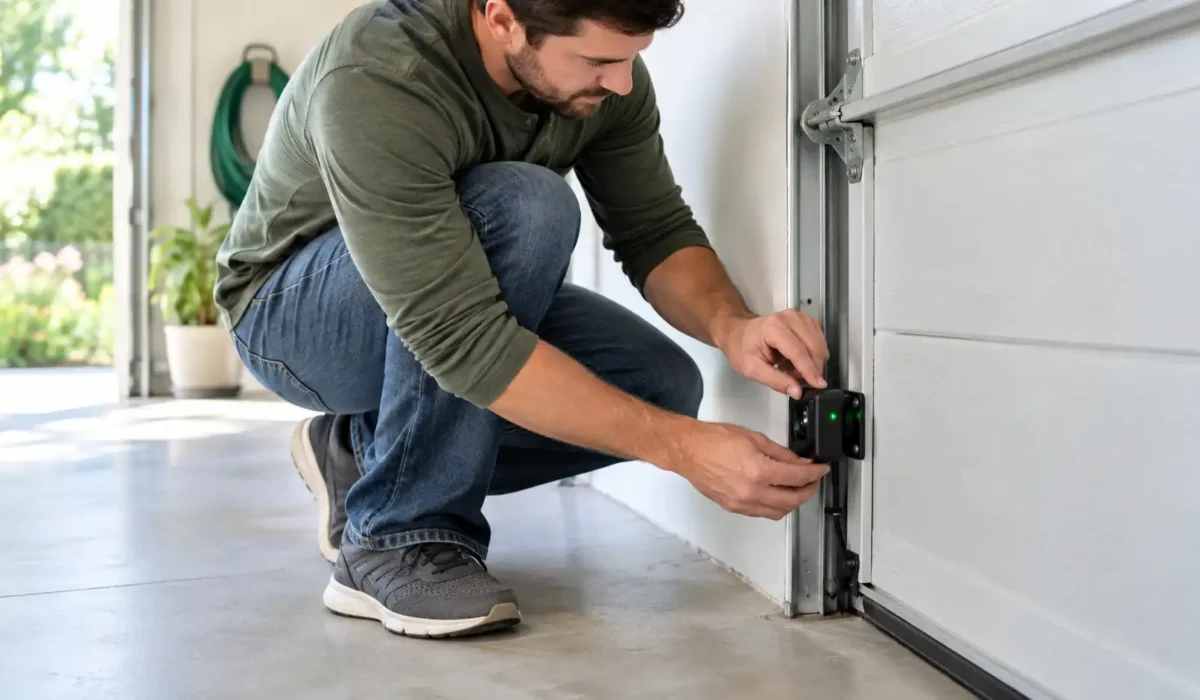
Near the bottom of each track, roughly six inches off the floor, sit two small photo-eye sensors facing each other. Garage door safety sensors misaligned is the single most common explanation for a garage door reverses when closing complaint, because these sensors are sensitive to even a slight bump or shift. Look at both units: if the indicator light on either one isn’t a steady, solid color, that’s usually your answer before you check anything else.
What Solid vs. Blinking Sensor Lights Actually Mean
Garage door sensor lights not solid green (or whichever steady color your brand uses) means the two sensors aren’t seeing each other properly, and the opener will refuse to complete the close cycle as a precaution. Learning how to align garage door safety sensors myself is genuinely one of the easier home-maintenance fixes on this list: loosen the wing nut or mounting screw on each bracket, gently adjust the angle until both lights turn solid, then retighten. It’s usually a five-minute job, not a repair call.
Clean the Lenses and Check for Debris
Even perfectly aligned sensors can misfire if the lenses themselves are dirty. Dust, cobwebs, pollen, and general garage door track debris build up on that little glass surface over months without anyone noticing. Debris in garage door track causing door to reverse is a separate but related issue — a leaf, a stray tool, or built-up dirt sitting in the track can create just enough resistance for the opener to interpret it as an obstruction. Wipe both sensor lenses with a soft, dry cloth, and run a visual check along the full length of both tracks while you’re down there.
The Close Limit Setting Might Be Off
If the sensors are aligned, clean, and clear, the next place to look is the opener’s close limit setting — sometimes labeled “down limit” or “travel limit” on the motor unit. This setting tells the opener exactly how far the door should travel before it’s considered closed. When garage door reverses before closing and the sensors check out fine, close limit setting causing garage door to reverse is a strong next suspect: if the limit is set slightly too far, the opener interprets the floor itself as an obstruction and reverses right as the door touches down.
Garage Door Stops a Few Inches From the Floor
There’s a meaningful difference between a garage door stops before hitting the ground entirely, well before contact, and one that reverses the instant it touches down. If you’ve noticed your garage door reverses a few inches from the floor rather than right at it, that pattern points more toward the tracks themselves — a section that’s slightly bent, pinched, or out of alignment creates resistance a few inches before full closure, and the opener’s force sensor reads that resistance as something blocking the door. This is also often what’s behind a report like why does my garage door go almost all the way down then back up, since “almost all the way” usually means the resistance shows up right near the very end of the travel. Running your hand along both tracks, feeling for any spot where they narrow or bow inward, often reveals the exact spot.
Why It Might Only Happen at Night
This one surprises people every time they notice it. Garage door reverses only at night but not during the day sounds like it should be electrical or mechanical, but it’s frequently about light. Direct sunlight hitting one of the photo-eye sensors during the day can occasionally mask a slight misalignment that becomes obvious once that sunlight is gone in the evening — the opposite problem of what you’d expect, but common enough that it’s worth testing your door at both times before ruling sensors out.
When It Reverses Every Single Time
A door that garage door reverses every time I try to close it, with no exceptions, usually isn’t a one-off fluke like a leaf in the track — it’s pointing at something constant: a sensor that’s now permanently misaligned, a close limit that’s meaningfully off, or a mechanical issue that’s present on every cycle rather than occasional debris. Consistency is itself a clue, and it’s worth treating a door that fails every time differently from one that only fails occasionally.
Track Balance, Springs, and When to Step Back
Occasionally, none of the above explains it, and the real cause is that the door itself is unbalanced or the torsion springs are wearing out. An unevenly weighted door creates ongoing resistance that the opener keeps misreading as an obstruction, cycle after cycle.
Garage door springs are under extreme tension and have caused serious injuries when handled incorrectly. Sensor alignment, lens cleaning, and clearing track debris are reasonable homeowner tasks. Anything involving the torsion springs, cables, or the door’s overall balance should be left to a licensed garage door technician.
| Normal, Healthy Close | Warning Sign of a Reversal |
|---|---|
| Both sensor lights stay solid the entire time | One sensor light flickers or goes dark briefly |
| Door travels smoothly at a consistent speed | Door visibly slows or hesitates before the floor |
| Door reaches the floor and the motor stops cleanly | Door touches down, then immediately lifts back up |
| Same behavior day and night | Works fine in daylight, fails after dark (or vice versa) |
A relative of mine dealt with this for almost two weeks before mentioning it, mostly because it seemed too minor to bother a repair company over. Their door would close fine most mornings and then start reversing every evening without fail. They’d assumed it was some kind of electrical gremlin. It turned out the setting sun was hitting one sensor at just the wrong angle for about twenty minutes each evening, right when they got home from work — a small tree trim and a slight sensor angle adjustment solved it completely. Nothing about the opener itself was ever actually wrong.
Frequently Asked Questions
How do I know if my garage door sensors are misaligned?
Check the small indicator light on each sensor unit near the bottom of the tracks. If either light is off, dim, or blinking instead of staying solid, the sensors aren’t lined up with each other properly and the opener will refuse to complete a close cycle as a safety precaution.
Can dirty sensor lenses cause a garage door to reverse?
Yes. Dust, cobwebs, and general garage grime build up on the lenses over time and can interfere with the beam even when the sensors are properly aligned. Wiping both lenses with a soft, dry cloth is a quick, free fix worth trying before assuming anything is mechanically wrong.
Why does my garage door only reverse at night?
This is usually about light, not electronics. Direct or low-angle sunlight hitting a sensor at certain times of day can sometimes mask a minor alignment issue that only becomes obvious once that light is gone. Testing the door at both daytime and nighttime helps confirm whether this is what’s happening.
How do I adjust the close limit on my garage door opener?
Most openers have a close limit (or “down limit”) adjustment screw or dial on the motor unit itself, usually near the back. Small clockwise or counter-clockwise turns in short increments, testing the door after each adjustment, will fine-tune exactly how far it travels before stopping. Consult your specific opener’s manual, since the exact dial location varies by brand.
Is it safe to disconnect the garage door sensors temporarily?
It’s technically possible on most openers, but it isn’t recommended even briefly. The sensors exist specifically to prevent the door from closing on a person, pet, or object, and disabling that protection removes an important safety layer for as long as it’s off. It’s safer to diagnose and fix the alignment or debris issue than to bypass the sensors.
Working through sensor alignment, lens cleaning, track debris, and the close limit setting in order resolves why does my garage door reverse before it closes far more often than people expect. Whether it’s a straightforward garage door sensor issue or a garage door won’t close complaint that’s been dragging on for weeks, most garage door reversing cases end with nothing more advanced than a soft cloth and a screwdriver.
Get a personalized checklist for your garage, doors, and more — generated in under two minutes.
See recurring exterior and seasonal tasks organized by month, so nothing gets forgotten.
Does your door reverse at the exact same point every time, or does it seem to change depending on the day?
Not sure what your home needs?
Build a free, personalized maintenance plan in under 2 minutes.
Build My Home PlanRelated Articles
 Electrical & Safety
Why Does My House Smell Like Fish When There’s No Fish? 7 Causes (One Is a Fire Warning)
A fishy smell with no fish in sight? Here are the 7 real causes — including one fire…
 Electrical & Safety
Why Does My Smoke Detector Beep Randomly? 7 Real Causes & Fixes
A random beep is rarely random. Here are the 7 most common causes of a chirping smoke detector…
 Seasonal Maintenance
How to Winterize Outdoor Faucets: 7 Steps Before the First Freeze
Winterize outdoor faucets before the first freeze with this simple 7-step checklist — protect pipes, prevent bursts, and…