Why Is My Water Pressure Low in Only One Faucet? (Real Causes)
Is it just the kitchen sink, or has the whole house gone weak? That one question is usually the fastest way to figure out why is my water pressure low in only one faucet — because a problem stuck at a single fixture almost always has a different cause than a whole-house pressure drop. The good news is that a single-faucet pressure problem is one of the more fixable plumbing issues a homeowner can run into, and most causes can be checked without opening a single pipe.
Below is the order to check things in, starting with the fastest fix and working toward the ones that genuinely call for a plumber. Whether it’s a low water pressure bathroom faucet or a kitchen tap that’s suddenly gone weak, a water pressure drop in one faucet almost always traces back to something local to that fixture rather than the plumbing system as a whole — which is exactly why knowing how to fix low water pressure in just one faucet usually comes down to a short checklist rather than tearing into any walls.
Start With the Faucet Aerator
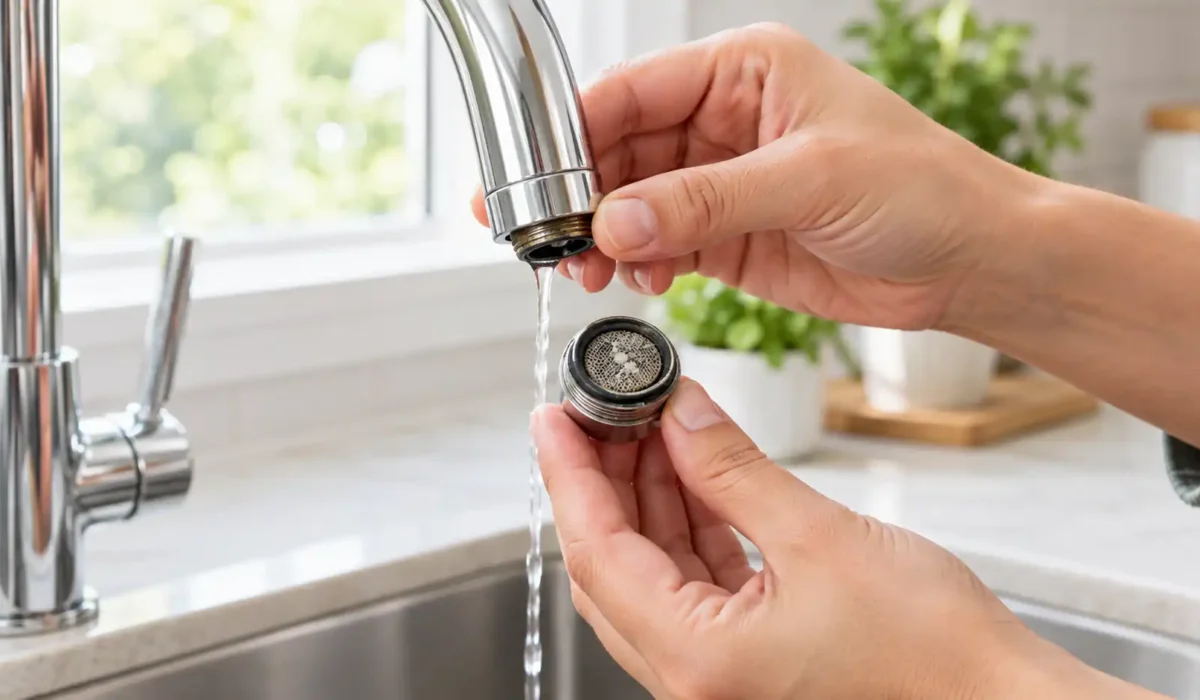
The aerator is the small mesh screen threaded onto the very tip of the faucet, and it’s responsible for more low water pressure kitchen sink complaints than almost anything else on this list. Hard water minerals build up inside that fine screen over months, gradually choking the flow until one day the stream feels noticeably weaker. A clogged faucet aerator low pressure problem is also one of the easiest to confirm: unscrew the aerator by hand, run the faucet without it, and if pressure jumps back to normal, you’ve found your answer. Soaking the aerator in white vinegar for an hour usually dissolves the buildup enough to restore full flow.
Check the Shut-Off Valve Under the Sink
Every sink has two small shut-off valves underneath it — one for hot, one for cold — and they’re easy to bump or leave partially closed after any plumbing work nearby. This is especially worth checking if the issue appeared right after a repair, since a shut off valve not fully open causing low water pressure is one of the most overlooked explanations homeowners run into. Reach under the sink and turn both valves fully counter-clockwise to confirm they’re wide open; a valve that’s only three-quarters open can quietly cut flow without anyone noticing until they’re specifically looking for it.
Inspect the Supply Line for Kinks or Damage
Between the shut-off valve and the faucet itself runs a flexible supply line, and these can develop a kink or a soft crush point over time, particularly in a cramped cabinet packed with cleaning supplies. A kinked supply line causing low water pressure in one faucet is easy to miss because the line often looks fine from the front — you usually have to follow its full length by hand to feel a pinch point. While you’re under there, check for any dampness or corrosion at the connection fittings too, since a slow leak upstream of the faucet can rob pressure just as effectively as a physical blockage.
Could the Faucet Cartridge Be the Real Problem?
If the aerator is clean and both valves are fully open, the next suspect is the faucet cartridge — the internal mechanism that controls flow and temperature every time you turn the handle. A faucet cartridge causing low water pressure in a single fixture is common in faucets past the five-to-ten-year mark, since mineral deposits and worn seals inside the cartridge restrict flow gradually rather than all at once. This is a real faucet cartridge issue rather than a whole-plumbing problem, and it typically means replacing just that one part rather than any larger repair.
Kitchen vs. Bathroom: Why One Fixture and Not the Other
It’s a fair question — why does my kitchen faucet have low water pressure but not the bathroom, when they’re supposedly fed by the same system? The answer is that each fixture has its own aerator, its own cartridge, and its own dedicated supply line and shut-off valves, so a localized problem in any one of those components affects only that fixture. One faucet has low water pressure but not others precisely because the issue lives in that fixture’s own hardware, not in the home’s shared plumbing. If more than one fixture were affected at once, that would point toward a shared cause further upstream, like the main shut-off valve or a pressure regulator.
Did This Start Right After a Repair or Renovation?
Timing is one of the best clues you have. Low water pressure after plumbing repair is common enough that it’s worth asking yourself directly: was any work done nearby recently? Low water pressure in one faucet only after replacing a valve often comes down to loose sediment that got knocked loose during the repair and is now lodged in the aerator or cartridge — which is exactly why checking the aerator first, even after a professional repair, makes sense before assuming something went wrong with the work itself. If you’re asking why did my water pressure suddenly drop in one sink and can trace it back to a specific day, that timeline usually points straight at whatever changed that day.
Test the aerator
Remove it and run the faucet bare. Pressure back to normal means you’re done.
Open both shut-off valves fully
Confirm the hot and cold valves under the sink are turned all the way open.
Feel along the supply lines
Check for kinks, crushed sections, or damp spots at the connections.
Consider the cartridge
If the fixture is older and the first three steps changed nothing, the cartridge is next.
Call a plumber
If pressure is still low after all of the above, or if you’re not comfortable disassembling the faucet, it’s a reasonable point to bring in a professional.
While researching how often this exact complaint comes up, one pattern stood out more than expected: an enormous share of “low pressure in one faucet” cases turned out to be the aerator, and almost nobody checks it first. Most people jump straight to assuming a bigger plumbing problem, when the actual fix was a five-minute soak in vinegar. It’s a reminder that the simplest explanation is worth ruling out before assuming the worst one.
Replacing an aerator or cleaning a supply line is a reasonable DIY task. Replacing a faucet cartridge is usually manageable too, but if you’re not confident working under a sink, or the issue turns out to affect more than one fixture at once, that’s the point to bring in a licensed plumber rather than guessing further.
Frequently Asked Questions
Can a clogged aerator cause low water pressure in one tap?
Yes, and it’s the single most common cause of low pressure at just one faucet. Mineral deposits from hard water build up inside the aerator’s fine mesh screen over time, gradually restricting flow until the stream feels noticeably weaker. Removing and soaking the aerator in vinegar usually resolves it.
How do I know if my faucet cartridge is bad?
A worn or failing cartridge typically shows up as reduced flow, a handle that feels loose or harder to turn than it used to, or water that dribbles rather than shuts off cleanly. If you’ve already ruled out the aerator, valves, and supply line, a cartridge that’s five or more years old is a reasonable next suspect.
Should I call a plumber for low water pressure in one faucet?
Not necessarily right away. Cleaning an aerator and checking that the shut-off valves are fully open are simple homeowner tasks worth trying first. If those don’t help, or the fix involves disassembling the faucet’s internal cartridge and you’re not comfortable doing that, calling a plumber at that point is a reasonable, practical choice.
Is low water pressure in one faucet normal after a repair?
It’s common enough not to be alarming. Loose sediment or mineral debris can get knocked free during nearby plumbing work and settle in the closest aerator or cartridge. Checking and cleaning the aerator first is a quick way to rule this out before assuming the repair itself caused a bigger problem.
How do I clean a faucet aerator myself?
Unscrew the aerator from the tip of the faucet by hand, or with pliers wrapped in a cloth if it’s stuck. Rinse out any visible debris, then soak it in white vinegar for about an hour to dissolve mineral buildup. Rinse it again, screw it back on, and test the flow.
Most of the time, the answer to why is my water pressure low in only one faucet turns out to be something small and local to that fixture — not a sign of a bigger plumbing failure. Work through the aerator, the valves, and the supply line in order, and you’ll usually find the cause well before you need to call anyone.
Get a personalized checklist for your plumbing, HVAC, and more — generated in under two minutes.
See recurring plumbing and seasonal tasks organized by month, so nothing gets forgotten.
Scenario A
Only one faucet feels weak, and everything else in the house runs normally.
Scenario B
Pressure feels a little low everywhere, and you’ve just never compared them side by side.
Which one actually matches what you’re dealing with? That answer alone points you toward the right fix.
Not sure what your home needs?
Build a free, personalized maintenance plan in under 2 minutes.
Build My Home PlanRelated Articles
 Water Heater & Appliances
Why Is My Dryer Taking So Long to Dry Clothes? (7 Real Causes)
You start a load before dinner, figure it’ll be done in an hour, and come back to clothes…