Why Is My Outdoor Faucet Still Dripping After I Turn It Off? (Normal vs. Real Problem)
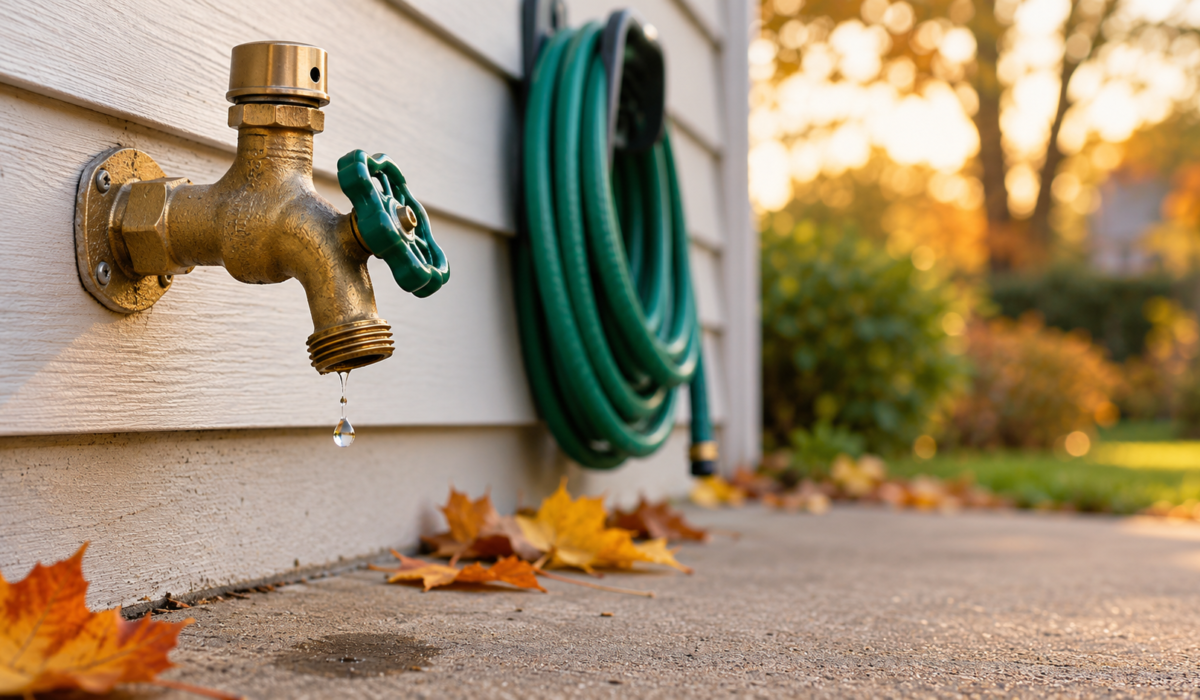
A few seconds of dripping after you close a frost-free outdoor faucet is usually normal. A drip that never stops, water showing up anywhere other than the spout, or dampness inside the house is a repair job.
If you are wondering why is my outdoor faucet still dripping after I turn it off, the answer depends on what kind of drip it is. After you close the handle, four very different things can be happening. One is plain drainage. One is a safety device doing exactly what it was built to do. One is a worn rubber part that costs very little to replace. And one is hidden freeze damage that can quietly soak a wall.
This guide helps you tell them apart in a few minutes, and it covers what to do before the first hard freeze. If you would rather work through it interactively, the Home Problem Finder walks you through common plumbing symptoms step by step.
Why is my outdoor faucet still dripping after I turn it off? Start with where the water is coming from
The location of the drip tells you more than its size. Close the handle firmly, watch the faucet for a full minute, then match what you see to the table below.
| Where the water appears | What it looks like | What it usually means | What to do |
|---|---|---|---|
| Spout, short drip | Drips for several seconds up to about a minute, then stops completely | A frost-free faucet draining its long stem | Nothing. This is normal |
| Spout, never stops | Steady drip or thin trickle that continues for many minutes | Worn stem washer or damaged valve seat | Replace the washer or stem, or the faucet |
| Top of the faucet or under the cap | A squirt or drip right after shutoff, often when a hose is attached | The vacuum breaker releasing water or pressure | Normal if brief. Constant leaking points to a worn seal |
| Under the handle | Water around the stem, but mostly while the faucet is turned on | Loose or worn packing nut or packing | Tighten gently, or replace the packing |
| Wall, siding or basement ceiling | Dampness, staining or dripping near where the pipe enters the house | A cracked stem or pipe, often from an earlier freeze | Shut off the water and call a plumber |
Why a frost-free faucet drips by design
A basic outdoor faucet keeps its valve at the outer end of the pipe, so water sits in the faucet body where the cold hits first and can freeze and split the metal.
A frost-free faucet solves this with a long stem, often several inches to a foot or more. The valve seat sits at the far end of that stem, inside the warm side of the wall. When you close the handle, the water is cut off deep inside the house, and the tube between the valve and the spout is left empty of supply. Whatever water remains in that tube has only one place to go: out through the spout. That is the drip you see right after shutoff.
A frost-free faucet that does not drain at all is actually the worse sign, because water left in the tube can freeze. The faucet needs a slight downward tilt toward the outside and no hose attached so the water can escape.
The vacuum breaker: when a spray is the safety feature working
Most modern outdoor faucets have a small device built into the top or the back, called a vacuum breaker or anti-siphon valve. Its job is to stop dirty water in a hose from being pulled back into your home’s drinking water supply. In many areas, plumbing rules require this protection on any faucet that accepts a hose.
The vacuum breaker also lets air into the faucet so the long stem can drain. When you shut the faucet off, this vent can release a squirt or a few drips. It is most noticeable when a hose with a closed nozzle is attached, because pressure trapped in the hose pushes back toward the faucet.
A simple fix for the splash is to open the nozzle at the end of the hose after you close the faucet, so the pressure bleeds off. Better still, disconnect the hose. Do not plug the vent or remove the vacuum breaker to stop the water. It is a protection device, and taking it off creates a different and more serious problem.
If the cap leaks constantly with no hose attached, the internal seal may be worn, and the vacuum breaker or the whole faucet usually needs replacing.
The real problems: worn washer, loose packing and freeze damage
A worn stem washer
At the end of the valve stem sits a small rubber washer. Every time you close the handle, it presses against a brass seat to seal off the water. After years of use, the rubber hardens or flattens and can no longer seal, so the spout keeps dripping long after the faucet should have emptied. This is the most common repair, and a new washer or stem assembly is often inexpensive. If the drip continues after a new washer, the brass seat itself is likely worn and the faucet should be replaced.
A loose or worn packing nut
Behind the handle, a packing nut presses a seal around the stem. If water seeps out around the handle mainly while the faucet is on, this is the likely cause. Tightening the nut a small fraction of a turn often stops it. Do not overtighten it.
Freeze damage you cannot see
When water freezes inside a faucet stem or the pipe behind it, the ice can split the metal, and you often will not know until spring. The faucet may look fine until you turn it on, and then water sprays inside the wall instead of out of the spout.
If you see wet drywall, staining on a basement ceiling near the faucet, water running behind the wall, or a drop in pressure at the faucet, stop using it. Close the water supply to that line, or the main shutoff if you cannot find a dedicated valve, and contact a licensed plumber.
Why leaving the hose on changes everything
A hose left attached makes almost every symptom harder to read. It traps water in the faucet, holds pressure against the vacuum breaker, and in cold weather can freeze solid and push ice back into the stem. A connected hose defeats the very design a frost-free faucet relies on.
It also gives you a useful diagnostic. If your faucet drips only while a hose is connected and stays dry without one, the vacuum breaker is probably the source. If it drips at the spout either way, you are looking at the washer or valve seat.
A five-minute test to settle it
A timed test answers why your outdoor faucet is still dripping after you turn it off better than guessing. You need a timer, a cup or paper towel, and a few minutes.
- Remove the hose, any splitter and any sprayer from the faucet.
- Turn the faucet on fully for about ten seconds, then close it firmly. Snug is enough; forcing the handle can wear the washer faster.
- Watch the spout, the top cap and the area under the handle for one full minute. Note which one is wet and whether the dripping slows down.
- Place a cup or a dry paper towel under the spout and leave it for ten minutes. A few drops means normal draining. A cup with a visible amount of water, or a soaked towel, points to a washer or seat problem.
- If you can reach the pipe from a basement or crawl space, check it while the faucet runs. Any moisture means stop and call a plumber.
What to do before the first freeze
Fall is the right time, because a small drip today can become a split pipe once temperatures stay below freezing. The routine is short and worth repeating every year.
- Disconnect every hose, splitter and sprayer, and store them indoors.
- If your faucet has its own indoor shutoff valve, close it, then open the outdoor faucet to let the line drain.
- Leave the outdoor faucet open through the winter so any remaining water has room to escape.
- Fix any steady drip now rather than waiting for spring.
Once you know why your outdoor faucet is still dripping after you turn it off, the fix is usually small. For the rest of your cold-weather preparation, the Seasonal Maintenance calendar and the Maintenance Checklist list the other jobs that belong on the same weekend. If you want a reminder schedule built around your own home, the Maintenance Planner can generate one.
Quick checklist before you move on
- Timed the drip with the hose removed: stops within about a minute, or keeps going
- Checked the top cap and the handle, not just the spout
- Looked for damp spots inside the wall, ceiling or basement near the faucet
- Replaced or booked a repair for any steady drip
- Disconnected and stored all hoses for winter
- Closed the indoor shutoff, if there is one, and left the outdoor faucet open
Frequently asked questions
Is it normal for an outdoor faucet to drip after turning it off?
For a frost-free faucet, yes, for a short time. The long stem drains after shutoff, so a drip lasting several seconds to about a minute is expected. A drip that continues for many minutes points to a worn washer or valve seat. Why does water come out of the top of my outdoor faucet?
That is usually the vacuum breaker releasing water or pressure, especially if a hose is attached. A brief release is normal. A constant leak from the top suggests a worn seal in the vacuum breaker. What is the vacuum breaker on an outdoor faucet?
It is a backflow protection device that prevents water in a hose from being siphoned back into your home’s drinking water. It also lets air in so the faucet can drain. It should stay in place. Can a dripping outdoor faucet freeze and burst?
Yes. Water left in the faucet or pipe can freeze and expand, and this can crack the stem or the pipe behind it. Removing hoses and draining the line before freezing weather lowers that risk. Should I leave a hose attached to an outdoor faucet in winter?
No. A connected hose traps water inside the faucet and stops it from draining, which is the situation that causes freeze damage even with a frost-free faucet. How do I know if my outdoor faucet is frost-free?
Frost-free faucets are noticeably long, with a barrel that extends back into the wall, and they usually tilt slightly downward. A standard faucet is short and sits flush against the wall. If you are unsure, check the model markings or ask a plumber. When should I call a plumber for an outdoor faucet leak?
Call one if you see moisture inside the wall, on a basement ceiling or behind the siding, if pressure drops, or if a new washer does not stop the drip. Those signs suggest damage beyond a simple part swap.
Not sure what your home needs?
Build a free, personalized maintenance plan in under 2 minutes.
Build My Home PlanRelated Articles
 Seasonal Maintenance
How to Winterize Outdoor Faucets: 7 Steps Before the First Freeze
Winterize outdoor faucets before the first freeze with this simple 7-step checklist — protect pipes, prevent bursts, and…